Anti-Corruption Policies

About PLBrasil Group
With over 20 years of tradition and a solid reputation for ethical conduct in the market, the PLBrasil Group is structured to serve companies across all sectors, as well as corporate legal departments and law firms—both in Brazil and abroad. The group provides high-quality paralegal services, including company incorporation and the regularization of licenses and registrations; legal representation; virtual office services (for corporate and tax purposes); registration of foreign capital in Brazil and Brazilian capital abroad; digital certification; due diligence; and the procurement of administrative and judicial certificates.
In addition to streamlining and resolving procedural issues in public and private agencies so that companies and their professionals can devote themselves fully to their strategic areas and their clients, our professional expertise and teamwork are dynamic, intellectually driven, and, as a result, more efficient.
In 2017, the PLBrasil Group reached an important milestone: the expansion of its areas of operation, incorporating translation services, insurance brokerage, and coworking solutions into its portfolio. More recently, we have carried out two significant expansions: the creation of Business Process Outsourcing (BPO) solutions—covering accounting, tax, finance, and payroll. And the launch of PLBrasil Health&Safety, a service that encompasses a range of technical, medical, and educational measures aimed at preventing workplace accidents and illnesses, thereby protecting the physical and psychosocial well-being of workers.
Our primary goal is to offer the best business solutions—combining efficiency and quality—to companies and foreign investors who wish to expand their investments and have a high-quality back office in our country.
Anti-Corruption Code
This Code is an integral part of the Manual and is intended to ensure that its members and correspondents understand the general requirements of anti-corruption laws, particularly Law No. 12,846/2013 and the law on corrupt practices abroad (FCPA—Foreign Corrupt Practices Act and UKBA—UK Bribery Act), while also serving as a preventive tool to guide members in recognizing and avoiding conflicts and violations of these laws.
The PLBrasil Group and its members are committed to conducting business in a lawful, ethical, transparent, and professional manner, and everyone is required to understand, accept, and follow the guidelines and policies set forth in this Manual. This is a significant responsibility, especially given the complexity and high risks involved in complying with the FCPA and UKBA. After reading this Manual, you must complete and sign the Statement of Commitment as proof that you have understood the message and will comply with it.
Failure to comply with anti-corruption laws may result in serious penalties for the PLBrasil Group or its members. This includes potential criminal liability for individuals involved in fraudulent payments—or those who have knowledge of and approve such payments—as well as disciplinary action by the company, which may extend to termination of employment and the forfeiture of benefits. The company will periodically verify that all individuals are acting in accordance with this Policy and applicable anti-corruption laws. Managers and coordinators are responsible for ensuring that the team members under their supervision adhere to the rules and guidelines set forth in this Manual. Any member who has questions or concerns regarding this Manual, or any anti-corruption law or regulation, should seek clarification from their direct manager. If necessary, the manager will consult with the Legal department or external legal counsel to provide the appropriate guidance.
Introduction
Important Considerations Regarding Law 12486/13
- 1. In January 2014, it was announced that Law No. 12,846, dated August 1, 2013, had entered into force; this law addresses the administrative and civil liability of legal entities for acts committed against the public administration. Among the changes announced, one stands out: the possibility of criminal penalties for entities in general.
- 2. Local laws must be obeyed. If compliance with this Manual would result in a violation of Brazilian law, local law must be followed, and managers and coordinators must be informed of the conflict.
- 3. From now on, companies involved in fraud will be subject to civil and administrative proceedings and may be fined between 0.1% and 20% of their gross annual revenue (when it is not possible to calculate this revenue, the amount may be determined by a judge and range from R$ 6,000 to R$ 60 million). In some cases, the court may even order the company to shut down.
- 4. This Manual supplements, but does not replace, the FCPA/UKBA Act and the Disciplinary and Ethics Manual.
Definitions
To facilitate understanding of anti-corruption laws, particularly Law No. 12,846 of 2013, the FCPA, and the UKBA, it is essential that all members be familiar with the following definitions:
CORRUPTION: It is the abuse of power or authority by a person to gain personal advantage. The most common form of corruption is bribery.
BRIBERY: It consists of offering, giving, or receiving something of value in exchange for favorable treatment from a company, an official authority, or a public official.
PUBLIC OFFICIAL (OR GOVERNMENT OFFICIAL): The term “public official” or “government official” includes all directors and employees of public or government-controlled enterprises. This term also encompasses family members of any such individuals (spouses, domestic partners, grandparents, parents, children, siblings, nieces/nephews, aunts/uncles, and first cousins). Listed below are certain authorities and categories of individuals considered “public officials” for the purposes of anti-corruption laws:
- Directors and employees of any government entity at the national, state, regional, municipal, or local level, including elected officials;
- Any individual acting temporarily in an official capacity for or on behalf of any government entity;
- Candidates for political office at any level, political parties, and their representatives; and
- Directors, employees, or official representatives of any public international organization, such as the World Bank, the United Nations, and the International Monetary Fund.
MONEY LAUNDERING: A series of commercial or financial transactions intended to integrate into the economy funds, goods, and services that originate from or are linked to illegal acts.
ADVANTAGE OR IMPROPER PAYMENT: Cash payments and any transfer of value, whether tangible or intangible, made to influence or reward any official act or decision by a public official.
GOVERNMENT ENTITIES: Refers to commercial enterprises, institutions, agencies, departments, and bodies owned or controlled by the government, as well as other public entities (whether the government holds full or partial ownership or control), including research institutions, universities, and hospitals.
FACILITATION PAYMENT: A small payment made to public officials to ensure or expedite the performance of an action or service to which a person or company is legally entitled. For example, small payments made to obtain authorizations, licenses, and other official documents; to process government documents, such as visas and work orders; to provide telephone services; and to supply water and electricity, etc.
KNOWLEDGE: Knowledge, as described in the FCPA and UKBA, is a broader term than “actual” knowledge. To violate the anti-corruption provisions of the law, a person must “know” that an illegal payment is being offered. Under the FCPA, knowledge exists when a person is aware that it is virtually certain that a particular result will occur or when they firmly believe that such a possibility exists.
ITEM OF VALUE: Includes money, gifts, travel, entertainment, job offers, and business meals. Any item of value may also include event sponsorship, scholarships, research support, and charitable contributions requested by or for the benefit of a government official, their family members—even if made to a legitimate charitable organization—corporate members, and any third party acting on behalf of the company. All third parties representing the PLBrasil Group—such as correspondents, service providers, business partners, and suppliers—will be informed of this Manual and will commit to complying with all applicable anti-corruption laws, which is a prerequisite for acting on behalf of the PLBrasil Group.
1. PLBrasil Group Values
Core values guide the PLBrasil Group’s anti-corruption policies. These values are based on legality, transparency, reliability, integrity, and social responsibility. The PLBrasil Group and its members are committed to conducting their business in a legal, ethical, transparent, and professional manner, and are obligated to understand, accept, and implement the anti-corruption policies and guidelines.
2. Scope
For the purposes of this Anti-Corruption Manual, we clarify that anti-corruption laws apply to all members, including third parties.
3. Anti-Corruption Laws
3.1 FCPA (Foreign Corrupt Practices Act)
The U.S. Foreign Corrupt Practices Act (FCPA), in general terms, strictly prohibits the payment of bribes to representatives of foreign governments for the purpose of obtaining, retaining, or directing business. The FCPA is the primary U.S. anti-corruption law, having been enacted by the U.S. Congress in 1977; it serves as the model for anti-corruption laws in several other countries and is the most important and effective anti-corruption statute.
Thus, under the FCPA, a company may not provide, offer, promise, or authorize the provision of anything of value to foreign government officials—whether directly or through an intermediary—for the purpose of influencing the officials’ actions to secure improper advantages. In practice, this prohibition is intended to prevent the provision of not only money but anything of value, including gifts, travel, meals or entertainment, donations, sponsorships, job offers, and other benefits that could personally advantage a public official or members of their family.
The FCPA established criminal and civil penalties for employees, officers, and representatives of companies that engage in acts of corruption abroad, whether such acts are committed by the parent companies or by their subsidiaries.
Enforcement of the FCPA involves the following agencies:
The U.S. Department of Justice, which enforces the law; and
The Securities and Exchange Commission (SEC), which is responsible for coordinating enforcement efforts.
The FCPA has two key principles: the anti-bribery provisions, which address bribes paid to public officials outside the United States, and the bookkeeping provisions, which address requirements for recordkeeping and internal controls. The following is a summary of these principles:
ANTI-BRIBERY PROVISIONS: The FCPA prohibits companies from making payments with a corrupt motive—whether directly or indirectly—to any foreign public official (including their family members), or to political parties, politicians, or political candidates (including their family members), for the purpose of obtaining or retaining business, securing a transaction with any person, or gaining any improper commercial advantage. For the purposes of the FCPA, an illegal payment may take the form of cash or any other item of value, or it may consist of other types of benefits, such as unnecessary or extravagant travel or entertainment. The FCPA covers payments made directly by a company, as well as those made indirectly through an intermediary, such as a business partner. Illegal payments may include bribes made to obtain or retain government contracts, or payments made to obtain any other benefit from a government official, such as a tax reduction, legal approval, a change in the law, or the receipt of necessary authorizations.
ACCOUNTING RECORDS PROVISIONS: The FCPA requires companies to maintain records that accurately and fairly reflect their transactions and to establish accounting controls to provide reasonable assurance that transactions are recorded accurately. False, misleading, or incomplete entries in these accounting records or other documents are prohibited. These requirements are intended to prevent companies from concealing bribes and to discourage fraudulent accounting practices; they apply to anyone acting on behalf of the company.
3.2 UKBA (UK Bribery Act)
The UK Bribery Act (UKBA) is a piece of British legislation aimed at combating and preventing corruption. It is considered one of the strictest anti-corruption laws in the world regarding corporate conduct; in many respects, the criteria set out in the UKBA go beyond those of its U.S. counterpart, the Foreign Corrupt Practices Act (FCPA). The Act has a transnational scope, as it applies not only to legal entities headquartered—or, at the very least, represented—in the United Kingdom (England, Wales, Scotland, and Northern Ireland), but also to entities that conduct business with legal entities established in the United Kingdom.
The UKBA was enacted by the British Parliament in April 2010 and took effect in July of the following year. This new law repealed and replaced the previous legislation, establishing four offenses:
Active bribery of public or private entities (Section 1);
Passive bribery of public or private entities (Section 2);
Bribery of foreign public officials (Section 6);
Failure of companies to prevent corruption (Section 7).
4. Key Features
The six principles:
The introduction of an offense concerning a company’s failure to prevent corruption is particularly innovative, as it emphasizes the benefits of prevention over mere repression, compelling companies to implement internal anti-corruption policies and procedures. This new criminal offense is unprecedented, as it applies directly to legal entities—or, in the terms of the law, “relevant commercial organizations”—at a time when the criminal liability of legal entities remains a relatively recent development. In this context, the British Ministry of Justice published non-binding guidance in March 2011 regarding the procedures set out in the law. The general principles of these guidelines can be summarized as follows:
1st Principle – Proportionate procedures: The procedures to be adopted must be proportionate to the perceived corruption risks, as well as to the nature, scale, and complexity of the activities carried out by the legal entity. Furthermore, these procedures must be clear, practical, accessible, and effective, and must be duly implemented and executed by the entity.
2nd Principle – Commitment from senior management: The entity’s senior management bodies must commit to anti-corruption measures and foster an organizational culture in which corruption is deemed unacceptable. This commitment must include methods for communicating this anti-corruption policy throughout the organization, as well as the direct involvement of senior management in the development of anti-corruption procedures.
Principle 3 – Risk Assessment: There must be a periodic, informed, and documented assessment of the nature and extent of an entity’s exposure to potential internal and external corruption risks. The most common external risks are categorized into five groups: country risk, sector risk, transaction risk, business opportunity risk, and business partnership risk.
Principle 4 – Due Diligence: Due diligence, proportionate to and guided by the level of risk, must be conducted regarding business counterparties.
Principle 5 – Communication (including training): Through internal and external communication and training measures, the anti-corruption policy must be embraced by the organization, to an extent proportionate to the risks it faces.
Principle 6 – Monitoring and Evaluation: Procedures designed to combat corruption must be monitored and evaluated, and necessary adjustments must be implemented whenever required.
5. Rules and Procedures
All members and third parties acting on behalf of the PLBrasil Group are required to comply with the rules and procedures detailed below, which are intended to ensure compliance with anti-corruption laws.
These rules and procedures cover the following matters involving public officials:
Bribery.
Meals, travel, and entertainment.
Gifts and gratuities.
Facilitation payments.
Third-party representatives.
Contributions to charitable causes.
Political contributions.
Sponsorships.
Acquisitions.
Accurate books and records.
If there are any questions regarding the proper application of the rules and procedures set forth in this policy, the employee should contact his or her immediate supervisor and/or coordinators.
It is the policy of the PLBrasil Group that, when conducting business, all its members and/or third parties acting on its behalf must fully comply with applicable anti-corruption laws and the law in general. Therefore, all those acting on behalf of the PLBrasil Group are prohibited from offering, promising, making, authorizing, or providing—directly or indirectly through third parties—any undue advantage, payments, gifts, or the transfer of anything of value to any public official (including their family members) for the purpose of influencing or rewarding any official action or decision by such person for the benefit of the company.
Anti-corruption laws, such as the FCPA, do not apply solely to the individual who pays a bribe; they also apply to individuals who act in a way that encourages such a payment—that is, they apply to any individual who:
Approves the payment of a bribe;
Provides or accepts false invoices;
Relays instructions for the payment of a bribe;
Conceals the payment of a bribe; or
Knowingly cooperates in the payment of a bribe.
No member will be penalized for delays or lost business resulting from their refusal to pay a bribe.
6. Relationships with Suppliers and Correspondents
These rules and procedures apply to all third parties representing the PLBrasil Group, such as correspondents, service providers, business partners, suppliers, etc. A third-party contract must be based on the business needs of the PLBrasil Group and the merits of the company or individual being contracted. No third party acting on behalf of the PLBrasil Group may exert improper influence over public officials. Furthermore, third parties must not have been recommended or nominated by public officials.
The PLBrasil Group conducts business only with reputable, honest, and qualified partners, and maintains appropriate procedures to carry out due diligence on any business partners in order to assess corruption risk before entering into any business dealings with them. The PLBrasil Group must also verify whether any such partner is known for engaging in corrupt practices, or is currently under investigation, facing legal proceedings, or has previously been convicted of such acts. In such cases, the PLBrasil Group shall investigate the facts and make a decision based on the findings, while taking into account the risk of damage to its reputation.
As of the date of this Manual, all contracts entered into with business partners must include clauses to ensure compliance with anti-corruption laws—specifically the FCPA—aimed at mitigating the risk of illicit payments and providing the company with the means to terminate the relationship in the event of any violations. Grupo PLBrasil will not tolerate any corrupt practices by its representatives.
7. Nepotism
The PLBrasil Group does not give preferential treatment to spouses, relatives, or relatives by marriage up to the third degree in employment relationships, the hiring of third parties, or the performance of contracts. All members must maintain impartial, ethical, and transparent conduct in all internal and external processes, as described in the company’s Code of Ethical Conduct.
8. Gifts, Giveaways, and Hospitality
It is considered good conduct to neither accept nor offer gifts or hospitality, nor to give gifts of any kind in exchange for services or benefits for oneself or on behalf of the PLBrasil Group. However, institutional gifts with no commercial value (such as office supplies, planners, pens, calendars, caps, and books) will be considered acceptable and, therefore, may be kept by the employee. Nevertheless, it is prohibited to sell such gifts and presents, either internally or externally.
Business meals should preferably take place at lunchtime and should be avoided during the negotiation and contracting phases. If a team member has questions about whether to offer or accept any type of gift or token of appreciation, they may contact their immediate supervisor, manager, or the PLBrasil Group’s Compliance department.
It is prohibited and unacceptable for members to solicit favors or gifts from business partners, whether for their own benefit or for that of their family members; it is also prohibited to give the impression that a transaction, contract, or decision depends on a favor, gift, or hospitality. It is prohibited and unacceptable for members to accept any kind of gift in the form of cash or its equivalent, regardless of the amount.
9. Support for and contributions to political parties
The PLBrasil Group does not provide support or make contributions to the political campaigns of candidates for elected public office. Accordingly, the dissemination or promotion of political campaigns and candidates in company materials, social media, documents, or any other internal or external company communications is prohibited.
10. Assets
It is the responsibility of all employees and staff members to safeguard the PLBrasil Group’s assets—both tangible and intangible—as well as its people, reputation, image, processes, and business information, and to combat any fraud, illegal acts of corruption, and data manipulation that could tarnish the company’s image and its assets.
11. Books and accounting records
The PLBrasil Group ensures the transparency and accuracy of its financial operations, guaranteeing that transactions are properly recorded in accordance with Brazilian and international accounting standards.
12. Corporate Excellence and Knowledge Sharing
The PLBrasil Group invests in training and knowledge sharing among our team, strengthening their expertise and corporate excellence. It is essential to communicate corporate policies to all employees and staff, as well as to raise awareness about activities involving fraud, corruption, money laundering, and bribery that could potentially affect the company’s business and reputation.
13. Channels for feedback, complaints, violations, and sanctions
It is the responsibility of all members to report any violations or suspected violations of the requirements of anti-corruption laws, particularly Law 12.846/2013, as set forth in this Manual. Reports of violations, whether identified or anonymous, must be directed to the Investigation Committee.
The PLBrasil Group supports and encourages employees, customers, and partners to report any indication of misconduct or violations of ethical principles, laws and regulations, policies, corruption, or improper or illegal conduct. To this end, the PLBrasil Group provides a reporting channel via its website or email, ensuring the confidentiality of the report and of the parties involved.
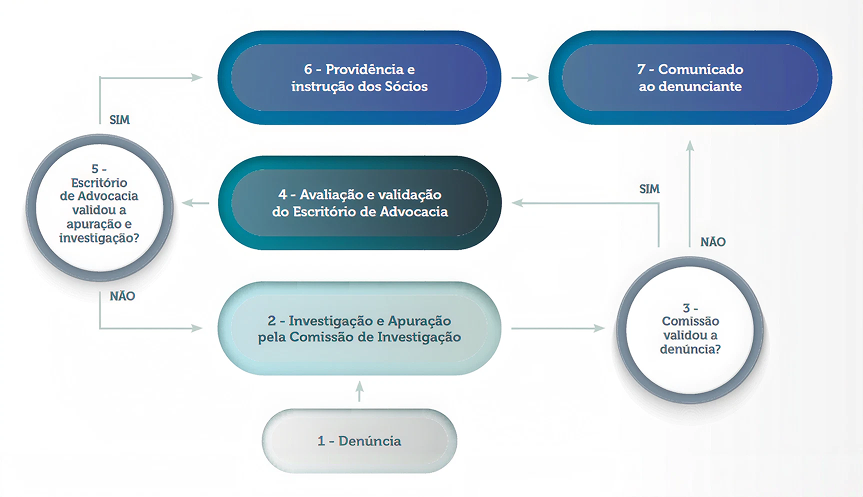
The Internal Investigation Committee shall be responsible for investigating cases impartially, examining evidence, and ensuring the anonymity of the whistleblower. Once the veracity of a report has been established, it will be forwarded to the PLBrasil Group’s law firm, which will validate the case in accordance with applicable laws. Final decisions will be determined by the company’s partners. The intentional provision of false information will not be tolerated, and the whistleblower shall be subject to the terms of applicable laws.
Investigation and Fact-Finding Process:
1 – Complaint
2 – Investigation and Review by the Investigation Committee
3 – Did the Committee validate the complaint? (NO: return to step 2; YES: proceed to step 4)
4 – Review and Validation by the Law Firm
5 – Did the Law Firm validate the findings and investigation? (NO: return to step 2; YES: proceed to step 6)
6 – Action and Guidance from the Partners
7 – Notice to the complainant
How to File a Complaint
Complaints must be based on concrete facts, especially if there is any connection to emotional or sexual harassment, discrimination, or any act of physical or psychological violence or abuse. To this end, the PLBrasil Group will need information such as: the name of the perpetrator, a description of the incident, dates, locations where the incident occurred, and the names of any witnesses. The absence of this information will compromise the investigation, the determination of the facts, and the results.
Regardless of whether reports of violations are identified or anonymous, the PLBrasil Group will take measures to protect the confidentiality of any report subject to applicable law, regulation, or legal proceedings.
13. Channels for feedback, complaints, violations, and sanctions
14. Non-Retaliation Policy
The PLBrasil Group will not permit or tolerate any form of retaliation against anyone who files a good-faith report or complaint regarding a violation of the anti-corruption policy. Any employee who engages in retaliation is subject to disciplinary action by the company, including termination of employment. Violations of Law 12.846/2013 may result in severe civil and criminal penalties for the PLBrasil Group and for the members and/or representatives involved.
15. Investigative Committee
To ensure impartiality and confidentiality in the investigation process, the names and positions of the Committee members—who may be from different levels of the company’s hierarchy—shall not be disclosed. One member of the Committee will be responsible for receiving the complaint through the channels provided by the PLBrasil Group and forwarding it to the other Committee members for further investigation of the facts.
16. Penalties Upon Confirmation of a Violation
Criminal penalties may be imposed on both individuals and legal entities. Penalties for legal entities include substantial fines, and their executives may also be imprisoned. In addition, the company may be ordered to return the proceeds obtained through the illegal act of corruption.
In addition to the penalties imposed by law, violations of the anti-corruption policy may be subject to disciplinary measures, which may include termination of the employee’s or representative’s contract and a recommendation to initiate legal proceedings.
Given the possibility of severe penalties, Grupo PLBrasil is committed to legal compliance through practices designed to protect its interests—such as due diligence processes, external audits, training programs, the inclusion of specific contractual provisions for representatives, and the implementation of internal controls and careful monitoring of company activities. Accordingly, Grupo PLBrasil prohibits all forms of bribery and requires its employees to comply with all applicable anti-corruption and related laws.
ALERT
To ensure compliance with anti-corruption laws—including the provisions set forth in Law 12.846/2013—all members must remain alert to “red flags” that may indicate the occurrence of improper advantages or payments. These red flags do not necessarily constitute proof of corruption, nor do they automatically disqualify third parties representing the PLBrasil Group. However, they do raise suspicions that must be investigated until we are certain that these indicators do not point to any underlying issues.
Members should investigate any of the following alerts:
Counterparty has a reputation for accepting bribes;
Counterparty requests an excessive commission, to be paid in cash or through other irregular means, without a receipt being provided by the public entity;
Counterparty is recommended by a public official;
Counterparty provides or requests questionable invoices or documents;
Counterparty refuses to include a written reference to anti-corruption measures in the contract;
Counterparty proposes an unusual financial arrangement, such as requesting payment into a bank account held by an unknown party, in a country other than where the service is being provided, or requesting payment to be split across multiple bank accounts;
The perception that a donation to a charity at the request of a public official is in exchange for government action.
NOTE:
The term “counterparty” as used in this Manual refers to a participant in a transaction. A transaction involves several participants who negotiate with one another, and each of them is a counterparty to all the others. For example, the seller is a counterparty to the buyer, and vice versa.
PRACTICES THAT WILL NOT BE PERMITTED:
Tax evasion or “off-the-books” accounting (*caixa dois*): the use or accumulation of unrecorded funds.
Tax evasion: practices that violate the law with the intent to reduce or conceal the occurrence of a taxable event, pursuant to Law No. 4,279/65 and Articles 1 and 2 of Law No. 8,137/90.
Active corruption (Article 322 of the Penal Code): offering or promising an undue advantage to a public official to induce them to perform, omit, or delay an official act.
Passive corruption (Article 317 of the Penal Code): soliciting or receiving—for oneself or for another, directly or indirectly, even outside of one’s official duties or prior to assuming them, but by reason of such position—an undue advantage, or accepting a promise of such an advantage.
Influence peddling (Art. 332 of the Penal Code): soliciting, demanding, charging, or obtaining—for oneself or for another—an advantage or a promise of an advantage, under the pretext of influencing an act performed by a public official in the exercise of their duties.
Money laundering (Art. 1 of Law 12.683/2012): concealing or disguising the nature, origin, location, disposition, movement, or ownership of assets, rights, or funds derived, directly or indirectly, from a criminal offense.
Piracy (Art. 184 of the Penal Code): the violation of copyright, intellectual works, or software, such as the unauthorized copying, use, sale, or distribution of such protected material.
Smuggling (Art. 334-A of the Penal Code): the importation or exportation of prohibited goods.
Counterfeiting/Forgery: copying, reproducing, or altering documents, products, or services without authorization, for the purpose of obtaining an advantage—typically of an economic nature.